


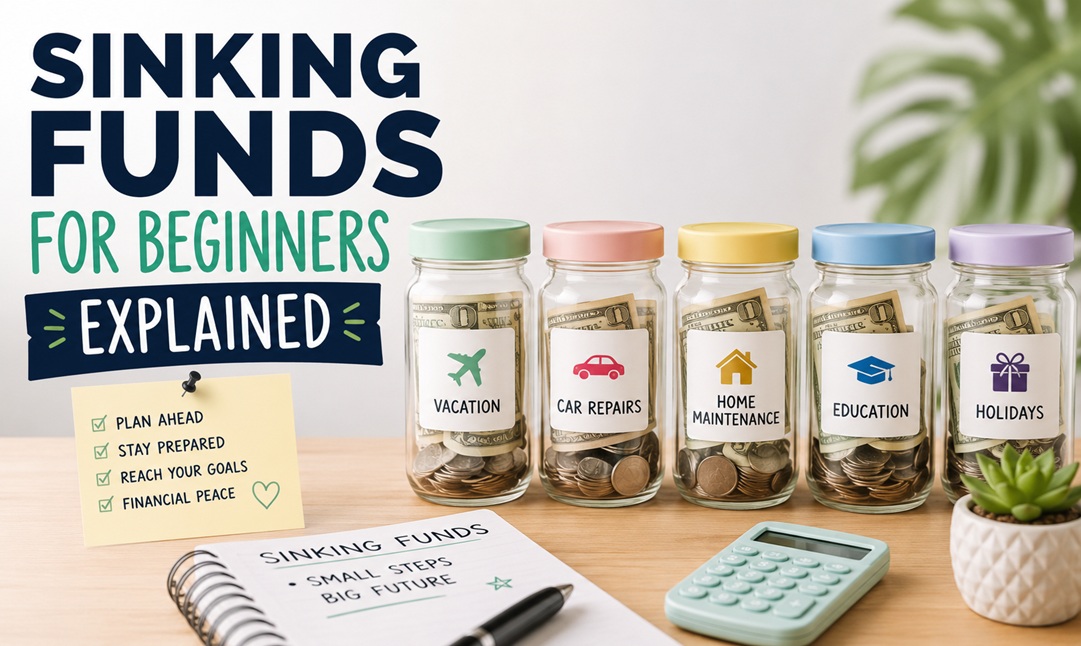
A sinking fund is a savings account — or a portion of one — set aside for a specific, planned expense. Unlike an emergency fund, which covers surprises, a sinking fund covers things you know are coming: car registration, a holiday, annual insurance premiums, Christmas gifts. You save a small, fixed amount each month so that when the expense arrives, the money is already there. No debt. No panic. No scrambling.
What Is a Sinking Fund and How Does It Work?
The name sounds more complicated than the concept. A sinking fund works on simple math: take the total amount you need, divide by the number of months until you need it, and save that amount monthly.
Say your car registration costs $600 and it is due in six months. You save $100 per month starting now. When the bill arrives, you already have the money.
That is it. The fund ‘sinks’ the cost of a future expense into manageable monthly portions.
People often use multiple sinking funds at once — one for holidays, one for car maintenance, one for home repairs. Each has its own target amount and monthly contribution.
Why Regular Savings Accounts Are Not Enough on Their Own
A general savings account is useful, but it does not tell you what the money is for. When you have $2,400 in savings and your car needs a $900 repair, you dip in. When the holiday you planned comes around three months later, the money has already been spent on something else.
Sinking funds solve this by giving each saved dollar a specific job. The money for the car and the money for the holiday are separate. Spending from one does not affect the other.
Common Beginner Mistakes
Starting Too Many Funds at Once
It is tempting to set up eight sinking funds on day one. The problem is that spreading small savings contributions across too many categories means each fund grows very slowly. Start with two or three funds covering your most predictable expenses. Add more once you have the habit established.
Setting Unrealistic Monthly Contributions
If your monthly sinking fund contributions collectively require more money than you actually have after bills, the system breaks immediately. Calculate your total available monthly savings first, then distribute across funds.
Using the Same Account for Everything
Keeping sinking funds in your main bank account without any separation makes it hard to track what belongs to what. Most people find that using separate savings accounts — or at minimum, named savings pockets within apps like Up Bank in Australia, Monzo in the UK, or YNAB — helps enormously.
How to Set Up Your First Sinking Fund
Write down three upcoming expenses you know are coming in the next twelve months. Include the approximate amount and the month they are due.
For each one, divide the total by the number of months remaining. That is your monthly contribution for each fund.
Open a savings account — ideally separate from your everyday account — and set up an automatic transfer on payday. Automatic is the key word. When it happens without your involvement, it actually happens.
Check the fund monthly. Adjust contributions if your income changes.
Next Steps
Once your first few sinking funds are running smoothly, expand to cover less obvious costs — irregular subscriptions, professional memberships, annual school supplies for children. These are expenses that always feel like surprises even though they happen every year.
If you use budgeting software, YNAB and PocketSmith both handle multiple sinking funds well and are popular among users in the US, Canada, UK, and Australia. Many people manage them with simple spreadsheets.
The goal is not a perfect system on the first attempt. It is building the habit of assigning a destination to money before it is needed.